One Mac mini, Five Sets of Books
One $1,299 Mac mini order creates five different accounting stories. Follow the journal entries, assets, liabilities and revenue clocks of the seller, lender, payment participants and carrier.
Part 1 of 2 · One purchase, several businesses
I ordered one computer. How many companies recorded the transaction?
I ordered a Mac mini for $1,299, payable over twelve months at $108.25 a month, at 0% APR. From my side of the purchase, the next step is simple: wait for a small box to arrive.
Now look at the order details below. Notice the price, the twelve installments, the interest rate, and the October 8–15 delivery window. Notice something else: the $39.99 annual AppleCare plan is a separate charge. Those few lines describe several different promises, each with its own accounting consequences.
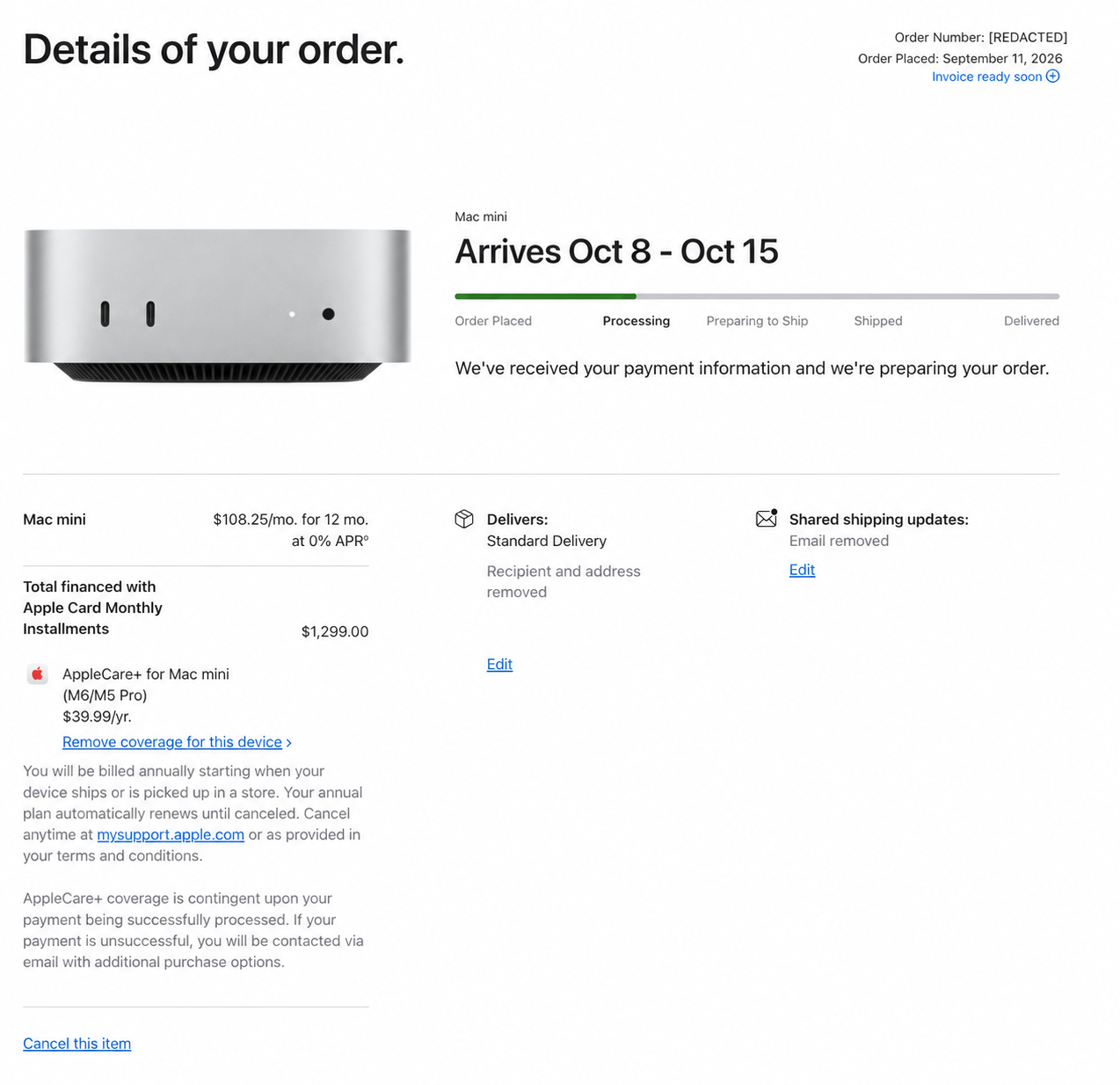
Order details, with personal information removed.
Let us follow this purchase all the way through. Assume Apple ships on October 8, the computer arrives on October 12, and I pay every installment. Later, we will rewind to October 20 and ask what changes if I return it instead. The future dates are assumptions for the example, rather than a report that delivery has already happened.
Apple sells the computer. Goldman Sachs Bank USA provides the Apple Card financing. Mastercard operates the card network. An acquirer/processor provides the merchant-side payment service, and a carrier delivers the parcel.
One Mac mini. Five business roles. Five sets of books in our example.
The acquirer is the easy one to miss: it arranges for a merchant to accept card payments and receive settlement. We combine acquiring and processing into one role here. Mastercard's annual report describes the issuer–acquirer structure behind these payments. The count is of roles, not necessarily five distinct legal entities; a group can operate through several subsidiaries, or one institution can perform several functions. We leave the acquirer and carrier unnamed. Their accounting is learnable without assigning Apple an unverified business partner.
The boundary is this order, its payment and financing, and its shipment, including a possible return shipment. We do not go upstream to chipmakers, assemblers, component suppliers, or the wider supply chain. The computer's cost is already sitting in Apple's inventory when our story begins.
Why do this exercise? A buyer should see the whole obligation behind a small monthly payment. A merchant should distinguish an order from revenue and revenue from cash. A bank should distinguish collecting its loan from earning income. An investor should know what each company's revenue number actually measures.
The question running through the essay is: whose books, which right or obligation, and at what moment?
Our completed-order timeline
All dates below are in 2026 unless stated otherwise. They form one consistent assumed sequence.
| Date | What we assume happens | What the accountant needs to distinguish |
|---|---|---|
| September 11 | I place a cancellable order; the bank authorizes the card | Permission to charge is not a completed sale or a funded loan |
| October 8 | Apple ships; the purchase is captured and posted | Apple recognizes the product sale in our case; the issuer records the loan |
| October 9 | The original card transaction settles; Mastercard is paid; the $38.97 product reward is paid | Short payment-system receivables and payables turn into cash movements |
| October 10 | Half the assumed transport service is complete | The carrier has earned half its $15 fee |
| October 12 | The computer arrives, within the promised window; the carrier invoices Apple | The carrier finishes its service; Apple does not sell the computer a second time |
| October 31 | Apple pays the carrier; I pay my first $108.25 installment | Two debts are reduced, without creating another product sale |
| Each following month-end, through September 30, 2027 | I pay another $108.25, twelve payments in total | The remaining loan principal reaches zero |
Apple says the first installment is billed at the end of the month in which the device ships. For this example, I voluntarily pay each installment on that billing day; these dates are our payment assumption, not a statement of the contractual payment deadline. Apple's installment billing guidance
Three payment words will recur. Authorization is permission to proceed. Clearing establishes who owes whom after a charge is submitted. Settlement moves the money to discharge those amounts. They can happen on different days.
Why put Apple's sale on October 8? Its annual revenue policy says control of delivered hardware and bundled software generally passes at shipment. We use that policy for our case. Apple's U.S. sales terms distinguish title at carrier pickup from loss or damage risk at receipt; successful delivery still matters even when revenue has already been recognized. We will place the alternative delivery-recognition entry after the main example.
Put numbers on the services before opening the books
The purchase price and installment amount come from the order. Every fee and cost in the next table is an explicit teaching assumption. The purpose is to make the journals reconcile, not to present Apple's private commercial contracts as public facts.
| Item | Amount | Meaning in our example |
|---|---|---|
| Computer price and loan principal | $1,299.00 | Twelve payments of $108.25 |
| Merchant payment-acceptance charge | $32.48 | Total charge deducted from Apple's settlement |
| Issuer interchange | $23.38 | The issuer's share of that charge |
| Mastercard network fee | $2.60 | Assigned to the acquirer side in this example |
| Acquirer/processor retained fee | $6.50 | The remaining payment-service revenue |
| Cash paid to Apple | $1,266.52 | $1,299 minus $32.48 |
| Carrier's fee to Apple | $15.00 | Standard delivery costs Apple something even if the customer pays no separate shipping fee |
| Computer's opening inventory cost | $800.00 | An assumed cost already on Apple's balance sheet |
| Expected basic warranty cost | $8.00 | Separate from the annual AppleCare plan |
The fee pool balances: $23.38 + $2.60 + $6.50 = $32.48. None of those amounts is an additional charge on top of the $32.48. We initially keep tax, AppleCare and any separate financing subsidy outside these hardware journals, then show how to add them.
In the tables, Dr means debit and Cr means credit. Debits increase assets and expenses; credits increase liabilities and revenue. The opposite entry reduces the relevant balance. A receivable is money owed to the company; a payable is money it owes. A contract liability is a promise still owed to a customer who has paid in advance.
Read each row as a separate balanced entry. Both columns must total the same amount. “No entry” means no financial recognition for that event; an order-management system can still record plenty of activity.
1. Apple: the computer leaves inventory, and a sale appears
September 11: order received
Our order is cancellable and only authorized. There is no sale entry and no cash entry. Apple still owns its inventory. Clicking Buy has created work for the fulfillment team, not $1,299 of earned revenue.
October 8–9: shipment, sale, and settlement
For the core example, allocate the $1,299 to the computer. The separate bundled-service refinement comes later.
| Date and event | Debit | Credit |
|---|---|---|
| October 8: recognize the sale | Settlement receivable $1,299.00 | Product revenue $1,299.00 |
| October 8: remove the computer's cost | Cost of sales $800.00 | Inventory $800.00 |
| October 8: provide for basic warranty service | Warranty expense $8.00 | Warranty liability $8.00 |
| October 9: receive net card settlement | Cash $1,266.52; Payment-acceptance expense $32.48 | Settlement receivable $1,299.00 |
The first receivable lasts a day in our timeline. It is a claim on the payment system, not my twelve-month loan. By October 9 Apple has collected the sale, while the bank still has to collect from me.
The settlement deduction also does not shrink Apple's revenue to $1,266.52. Apple sells the product for $1,299 and buys a payment service for $32.48. One is revenue; the other is an expense.
October 10–31: receive delivery service and pay for it
| Date and event | Debit | Credit |
|---|---|---|
| October 10: half the transport service received | Delivery expense $7.50 | Accrued carrier payable $7.50 |
| October 12: remaining service received | Delivery expense $7.50 | Accrued carrier payable $7.50 |
| October 31: pay the carrier's $15 invoice | Carrier payable $15.00 | Cash $15.00 |
The carrier's October 12 invoice confirms the $15 already accrued; processing it must not create another $15 expense. The accountant can move the balance from an accrued-payables account to trade payables if the chart of accounts separates them.
Delivery completes the journey; it does not create a second $1,299 sale. My later installments do not create more Apple revenue either. Warranty service, if needed, uses the provision: Dr Warranty liability; Cr Cash/parts/payables. We assume no claim in the completed-order case, while retaining the $8 estimate for the expected obligation at sale.
Before any financing subsidy, shared overhead, or tax, Apple's core order result is $1,299 − $800 − $32.48 − $15 − $8 = $443.52. That is a useful subtotal, not Apple's final net profit. Part 2 follows the remaining costs.
2. Goldman Sachs: the bank acquires a right to be repaid
The issuer is Goldman Sachs Bank USA. Apple announced an intended transition to Chase in January 2026, expected to take approximately twenty-four months, with Goldman continuing to service accounts during the transition. We retain Goldman throughout our assumed repayment period. Apple's transition announcement
September 11 through October 12: authorize, lend, and settle
At authorization on September 11 there is no funded loan in our example. The amount can reduce available credit, but the bank has not yet advanced the purchase money.
| Date and event | Debit | Credit |
|---|---|---|
| October 8: post the financed purchase | Cardholder loan receivable $1,299.00 | Settlement payable $1,299.00 |
| October 8: recognize interchange entitlement | Settlement payable $23.38 | Interchange fee income $23.38 |
| October 9: settle net | Settlement payable $1,275.62 | Cash $1,275.62 |
| October 9: recognize the product reward | Reward expense $38.97 | Rewards payable $38.97 |
| October 9: pay the reward | Rewards payable $38.97 | Cash $38.97 |
These rows show the gross obligation and its net cash settlement. Real systems settle batches, but the economic point survives: advancing $1,299 creates a loan asset, not a $1,299 expense.
The reward is 3% × $1,299 = $38.97, using Apple's advertised Daily Cash benefit. We assume the issuer bears that cost; presentation as expense or a reduction of related income depends on the arrangement. Apple Card benefits
On October 12, successful parcel delivery creates no second loan and no new interest income for Goldman. Its asset is already the customer's obligation to repay.
October 31 onward: principal declines, costs continue
Every principal payment is Dr Cash $108.25; Cr Cardholder loan receivable $108.25. Billing a scheduled installment does not create another loan on top of the original balance.
| Payment date | Principal collected | Principal still owed afterward |
|---|---|---|
| October 31, 2026 | $108.25 | $1,190.75 |
| November 30, 2026 | $108.25 | $1,082.50 |
| December 31, 2026 | $108.25 | $974.25 |
| January 31, 2027 | $108.25 | $866.00 |
| February 28, 2027 | $108.25 | $757.75 |
| March 31, 2027 | $108.25 | $649.50 |
| April 30, 2027 | $108.25 | $541.25 |
| May 31, 2027 | $108.25 | $433.00 |
| June 30, 2027 | $108.25 | $324.75 |
| July 31, 2027 | $108.25 | $216.50 |
| August 31, 2027 | $108.25 | $108.25 |
| September 30, 2027 | $108.25 | $0.00 |
The twelve collections total $1,299. None is revenue from lending the principal. Consumer interest on this installment balance is zero in our case.
Goldman still incurs costs. Funding accrues as Dr Funding interest expense; Cr Interest payable, followed by Dr Interest payable; Cr Cash when paid. Servicing is Dr Servicing expense; Cr Cash/payables. At Part 2's assumed 5% annual funding rate, the dated principal path carries $33.57 of allocated funding cost, even though every installment is paid.
The customer's 0% is a price, not the bank's cost of funds. This will be central to the economics.
A reporting note: contractual principal and carrying value differ
The tables track what the customer owes. The reported loan asset can be lower. Goldman classified its Apple Card portfolio as held for sale, and its disclosures discuss valuation markdowns. A simplified adjustment is Dr Loan valuation loss M; Cr Loan valuation adjustment M, where M is the required markdown. It reduces the recorded asset, not the customer's legal debt. Goldman's loan disclosure, July 2026 results
A held-for-investment lending example might instead use a credit-loss allowance. Do not put both treatments on this same exposure without justification. For learning the payment flow, keep the $1,299 contractual principal separate from its accounting valuation.
3. The acquirer and processor: collect, deduct, and pass money onward
The acquirer serves Apple on the merchant side. It arranges acceptance and settlement; it does not earn the computer's entire selling price.
On September 11 it passes the authorization message. We assume any small message fee is included in the completed transaction's $6.50 retained fee, with no separate order-day fee entry.
| Date and event | Debit | Credit |
|---|---|---|
| October 8: establish clearing balances | Due from issuer $1,299.00 | Due to Apple $1,299.00 |
| October 8: deduct the merchant charge | Due to Apple $32.48 | Interchange payable $23.38; Network fee payable $2.60; Processing revenue $6.50 |
| October 9: receive issuer settlement net of interchange | Cash $1,275.62; Interchange payable $23.38 | Due from issuer $1,299.00 |
| October 9: pay Apple | Due to Apple $1,266.52 | Cash $1,266.52 |
| October 9: pay Mastercard | Network fee payable $2.60 | Cash $2.60 |
Follow the cash: $1,275.62 in − $1,266.52 to Apple − $2.60 to Mastercard = $6.50 retained. All original clearing receivables and payables are now zero.
We assume this participant acts as agent for the onward interchange and network amounts and reports its retained fee as revenue. Gross-versus-net reporting is an accounting-policy question; we choose the net presentation explicitly rather than mistake payment volume for revenue.
Its own costs are Dr Processing/servicing expense; Cr Cash/payables. Delivery on October 12 and my later repayments produce no additional sale-processing revenue in this model. Refunds or disputes can create new work, which we will shortly see.
4. Mastercard: a network service earns a network fee
Mastercard carries payment messages and provides network services. We aggregate the billable authorization and clearing services into one $2.60 fee, earned on October 8 and collected on October 9.
| Date and event | Debit | Credit |
|---|---|---|
| October 8: earn the network fee | Network-fee receivable $2.60 | Network revenue $2.60 |
| October 9: collect it | Cash $2.60 | Network-fee receivable $2.60 |
| As network costs arise | Network operating expense | Cash/payables |
The $23.38 interchange is the issuer's income; it is not Mastercard revenue. The $1,299 is payment volume, not Mastercard's sale or consumer loan. Mastercard makes these distinctions in its annual report.
The parcel's arrival does not earn another network fee in our example. Neither do the twelve loan-principal collections. Network businesses can have other settlement exposures and guarantees; the narrower point here is that Mastercard has not advanced this consumer loan.
5. The carrier: transportation is the product it sells
The carrier carries a $1,299 computer but sells $15 of transportation. The box does not become the carrier's inventory simply because its driver has custody of it.
We use UPS's disclosed policy of recognizing transport revenue as goods move as a public reference. UPS is a benchmark here, not an identification of our carrier. UPS revenue-recognition policy
On September 11, booking a future delivery creates no transport revenue. Collection on October 8 starts the service; it does not instantly earn the entire fee. Assume performance is 50% complete on October 10 and complete on October 12, with payment becoming unconditional when delivery is complete.
| Date and event | Debit | Credit |
|---|---|---|
| October 10: half the service performed | Unbilled contract asset $7.50 | Transport revenue $7.50 |
| October 12: remaining service performed | Unbilled contract asset $7.50 | Transport revenue $7.50 |
| October 12: raise the invoice | Trade receivable $15.00 | Unbilled contract asset $15.00 |
| October 31: Apple pays | Cash $15.00 | Trade receivable $15.00 |
A contract asset records earned consideration whose collection still depends on completing something else. Once only the passage of time stands between the carrier and payment, the balance becomes a receivable. The invoice changes the type of asset; it does not create a second $15 of revenue.
The carrier records wages, fuel, and other transport costs as Dr Transport expense; Cr Payroll/fuel/other payables. Vehicle and hub depreciation is Dr Depreciation expense; Cr Accumulated depreciation. Cash payments later clear the payables. Those are its costs of earning $15, not costs measured as a percentage of the computer's value.
Take a balance-sheet photograph on October 31
Assume the carrier and original payment-system balances have been settled, and the first installment has been paid. This is a view of the core hardware order, before the separate extensions below.
| Participant | Revenue or income earned from the core services | What remains from this order on the balance sheet? |
|---|---|---|
| Apple | $1,299 product consideration in our simplified allocation | Original inventory and settlement receivable are gone; carrier payable is zero; the $8 warranty liability remains, subject to remeasurement |
| Goldman issuer | $23.38 interchange; zero consumer interest on the installment | $1,190.75 contractual principal remains, subject to applicable valuation; funding/operating payables depend on when those bills are paid |
| Acquirer/processor | $6.50 retained fee | Original clearing balances are zero; cash and any unpaid operating costs remain |
| Mastercard | $2.60 network fee | Fee receivable is zero; cash and any unpaid operating costs remain |
| Carrier | $15 transport fee | Contract asset and customer receivable are zero; shared transport assets and any unpaid operating costs remain |
These are transaction-related balances, not complete company balance sheets. The revenues also cannot be added and called independent shares of $1,299: Apple's payment and freight expenses fund other participants' revenues. Loan principal passes through balance sheets without becoming income.
Add tax, coverage, and the remaining accounting refinements
Sales tax: choose a number, then keep it out of revenue
Assume 10% sales tax on the hardware, solely to illustrate the entries, not as a claim about the applicable local rate. That is $129.90 in addition to the $1,299 price.
On October 8 Apple records Dr Tax settlement receivable $129.90; Cr Sales-tax payable $129.90. Collection clears the receivable; remittance clears the liability. We assume both happen in October. The tax is money Apple collects for a government, not product revenue.
At the issuer, the added amount is Dr Ordinary card receivable $129.90; Cr Settlement payable $129.90; paying the merchant-side settlement clears that payable. Assume I pay this ordinary balance in full on October 31. Dr Cash $129.90; Cr Ordinary card receivable $129.90 clears it without interest in this example. Apple's terms exclude tax from ACMI's interest-free installments. ACMI terms
The acquirer passes the tax collection through corresponding receivable/payable accounts. We leave additional tax-related payment fees and rewards outside this extension so it isolates the tax liability; the original hardware fee table is unchanged.
AppleCare: an annual payment is earned over a coverage period
Assume the separately billed $39.99 annual plan starts on October 8, is paid at shipment, and runs through October 7, 2027. The Apple-group entry is Dr Cash/receivable $39.99; Cr Deferred service revenue $39.99.
Assuming an even service pattern, release the liability into revenue as time passes: Dr Deferred service revenue; Cr Service revenue. At 24 covered days through October 31, that is $39.99 × 24/365 = $2.63, leaving $37.36 deferred. Over the full coverage year, total earned revenue reaches $39.99. Covered-service costs are recorded as incurred; Part 2 uses a pool's expected claims to assess profitability.
At legal-entity level, Apple's published Mac service terms identify AppleCare Service Company, Inc. as provider and Apple Inc. as administrator. A collecting agent records Dr Cash; Cr Due to provider, while the provider records Dr Due from collecting agent; Cr Deferred service revenue. Remittance clears those balances; group consolidation eliminates them. This is why five business roles need not mean precisely five legal entities. AppleCare contract terms
Three refinements to keep separate from the core journals
Bundled services. Apple's revenue policy allocates some product consideration to services performed later. If that amount is B, the October 8 entry becomes Dr Settlement receivable $1,299; Cr Product revenue $(1,299 − B); Cr Deferred bundled-service revenue $B. Recognize B over the service period. Our core table deliberately sets this allocation aside to expose the sale and settlement mechanics.
A contract that transfers control on delivery. If the applicable contract instead makes October 12 the recognition date, an earlier collection creates Dr Cash; Cr Customer advance. Keep the inventory until delivery. On October 12 record Dr Customer advance $1,299; Cr Revenue $1,299, and Dr Cost of sales $800; Cr Inventory $800. A later recognition date changes timing, not the total number of sales.
Merchant support for financing. Part 2 assumes a separate $65 Apple-to-issuer payment and tests alternatives. Its accounting depends on what the contract buys: a distinct service can produce service expense/income as performed; a payment tied to loan origination can affect the loan's yield or carrying value. An advance for a future service begins as a prepaid cost for the payer and deferred consideration for the recipient. Do not turn the modeled subsidy into a second consumer-interest charge. The $65 is outside our core hardware journals, and its return treatment is stated separately in Part 2.
Rewind: what if I return the computer instead?
Now branch away from the completed-order story. Assume I request a return on October 20, the carrier collects it on October 21, Apple receives and accepts it on October 22, and the hardware refund settles on October 23. This is before the first installment payment. Apple's standard U.S. policy allows eligible returns within fourteen days of receipt; our October 22 return is within fourteen days of October 12 delivery. Apple's return policy
Choose the commercial assumptions explicitly:
- Apple refunds the full $1,299 hardware price. The recovered computer is worth $760 against its original $800 carrying cost. We assume no warranty claim and release the $8 product-warranty provision.
- The issuer returns its $23.38 interchange. Mastercard keeps $2.60 and the processor keeps $6.50. No participant charges an additional refund-processing fee, although processing still costs them money.
- The carrier keeps its $15 outbound fee and charges Apple $12 for the return journey, completed October 22. Apple pays both freight invoices on October 31.
- The already-paid $38.97 Daily Cash is charged back to my ordinary card balance, which I pay on October 31. It is not deducted from a nonexistent unpaid rewards liability.
The fee-refund choices are hypothetical contract terms. Apple's published installment guidance does establish the consumer mechanism: an eligible device return closes remaining installments, credits the installment balance, and charges the associated Daily Cash back to the card. Apple's return and installment guidance
Apple: reverse the sale, recover an asset, and retain some costs
| Date and event | Debit | Credit |
|---|---|---|
| October 22: accept the hardware return | Sales returns $1,299.00 | Refund payable $1,299.00 |
| October 22: recover the computer at its reduced value | Returned inventory $760.00; Return-related loss $40.00 | Cost of sales $800.00 |
| October 22: release unused warranty provision | Warranty liability $8.00 | Warranty expense $8.00 |
| October 22: accrue completed return transport | Return-delivery expense $12.00 | Carrier payable $12.00 |
| October 23: settle refund net of recovered interchange | Refund payable $1,299.00 | Cash $1,275.62; Payment-acceptance expense $23.38 |
| October 31: pay outbound and return freight | Carrier payable $27.00 | Cash $27.00 |
The credit to payment-acceptance expense reverses the refunded part of the original $32.48 cost, leaving $9.10. Net hardware sales revenue is now zero. Apple has a $760 asset back, but has incurred $40 of inventory loss + $9.10 of retained payment fees + $27 of freight = $76.10 before handling, shared overhead, and other costs. The original $800 cost is not lost a second time.
These rows isolate a single return. In actual financial reporting, expected returns can already have created a refund liability and a return-recovery asset at the original sale. The eventual return then uses those balances and records any difference, rather than reversing revenue twice.
Goldman: close the installment asset and recover the reward
| Date and event | Debit | Credit |
|---|---|---|
| October 23: process the full hardware credit and reverse interchange | Settlement receivable $1,275.62; Interchange income $23.38 | Cardholder installment loan $1,299.00 |
| October 23: receive net refund settlement | Cash $1,275.62 | Settlement receivable $1,275.62 |
| October 23: recover paid Daily Cash from the customer | Ordinary card receivable $38.97 | Reward expense $38.97 |
| October 31: customer pays that ordinary balance | Cash $38.97 | Ordinary card receivable $38.97 |
The installment loan is zero and the twelve future payments disappear. The reward recovery is a separate balance until paid. Funding and servicing already consumed are still costs. Any valuation adjustment relating to the extinguished loan must also be cleared; it cannot remain attached to an asset that no longer exists.
Had I already paid one installment, a full hardware refund would clear the remaining $1,190.75 and leave $108.25 of customer credit, before reward adjustment and any other card balances. That is why the timing of the return matters.
Acquirer and Mastercard: reverse the right amount, not all history
The acquirer collects the $1,275.62 net refund from Apple and passes it to Goldman:
| October 23 acquirer entry | Debit | Credit |
|---|---|---|
| Establish net refund clearing balances | Due from Apple $1,275.62 | Due to issuer $1,275.62 |
| Collect from Apple | Cash $1,275.62 | Due from Apple $1,275.62 |
| Pay issuer | Due to issuer $1,275.62 | Cash $1,275.62 |
Its $6.50 revenue survives under our chosen terms. Mastercard's $2.60 also survives, so Mastercard records no fee-revenue reversal. Both record the extra work as Dr Refund-processing expense; Cr Cash/payables, even though neither charges a new fee. A refund is not free to operate just because it is free to the customer.
Carrier: the return is another sale of transportation
The outbound $15 is already earned. The return adds $12, earned as the parcel travels October 21–22. For a return entirely within the same reporting period, the completion entries can be summarized as Dr Trade receivable $12; Cr Return-transport revenue $12, alongside the associated transport-cost accruals. If a reporting cutoff fell during the journey, accrue the service by progress as before.
On October 31 the combined collection is Dr Cash $27; Cr Trade receivable $27. Apple's product sale has been reversed; the carrier has now performed two services.
Tax and AppleCare unwind separately
Under our 10% tax extension, Apple also refunds $129.90. Assume the tax has already been remitted and Apple is entitled to recover it: Dr Tax recoverable $129.90; Cr Customer tax-refund payable $129.90. Refunding clears that payable; the later tax credit or recovery clears the asset. If it had not yet been remitted, reduce tax payable instead. The card system passes the refund through and the bank credits the ordinary tax balance, which we assumed had not yet been paid. Tax never becomes a refund expense in this example.
For AppleCare, assume separate cancellation on October 23, no claims, and an approved full $39.99 refund. This is a chosen refund outcome, not a claim that returning hardware automatically guarantees it for every recurring plan. Apple's cancellation guidance distinguishes recurring plans and directs customers to the applicable terms.
For a concrete journal, suppose $1.64 has been earned over fifteen covered days through October 22 and $38.35 remains deferred. Record Dr Deferred service revenue $38.35; Dr Service-revenue reversal $1.64; Cr Refund payable $39.99. Paying the refund clears the payable. Any administration or service costs already incurred remain costs. A refund of the annual price does not erase work already performed.
What the same purchase teaches us
On October 8, the computer becomes Apple's sale and the bank's loan. On October 12, the carrier finishes earning its transport fee. On October 31, paying debts changes cash and liabilities or receivables, without repeating those sales. By September 30, 2027, the successful case's installment principal is fully repaid.
In the return branch, the product revenue disappears, a reduced-value inventory asset comes back, the loan closes, and several costs survive. Another shipment can even create new revenue for a different participant.
The transaction is understandable once we stop asking whether it has “happened” in the abstract. Ask which company has performed a service, acquired a right, incurred an obligation, or simply moved cash.
That is why accounting belongs in Alloconomy. Before deciding whether a business creates value, we need to know what its numbers describe. The next essay uses this same timeline and return branch to ask who earns a profit, on what revenue base, and after which costs.
Next: Beyond Accounting: Who Actually Profits from My Mac mini?
Company disclosures establish the roles and accounting policies; fulfillment dates, negotiated fees, costs, tax rate, and return outcomes are illustrative assumptions. Public policies for installment billing, returns, and plan cancellation checked September 12, 2026. Earlier company-reporting references retain their stated reporting dates.